

ALMA - The Incarnation of the Mad God (2020 - 20XX)
Updated: Jul 20

Alma is a Tactical-RPG that sits somewhere between Final Fantasy Tactics and a Pokémon-like game. It takes place in a fantasy world where humans live alongside deities – sometimes cute spirits seeking refuge deep within the fireplace to escape the biting cold of winter, sometimes valiant beasts seeking an honourable challenge. Sometimes legendary creatures with powers defying the very origins of the world, which must be appeased with numerous offerings and prayers.
Letter of Intent
The video game Alma is not intended strictly for children and, as a result, does not seek to imitate the storytelling style of Pokémon – quite the opposite, in fact. Alma aims to speak to those who grew up with Pokémon but who, as adults, wish to discover a world with more nuanced shades. Hence these Almas, which certainly carry dreams, but which can also embody both wondrous landscapes and unspeakable carnage. However, to avoid the narrative becoming too heavy-handed, the idea is to construct the story through two possible protagonists.
Thus, at the start of a new game, the player will be given the choice of playing as a child or an adult. The child will begin in a small village and, having chosen their ‘starter’ following a series of events, will be able to explore the world more freely. The NPCs will speak in a manner suited to the child’s youth, shielding them from some of the darkest horrors that plague the world of Alma. This will therefore offer a more ‘classic’ adventure, where exploration and encounters with Almas take centre stage. It will, of course, be possible to glimpse the underlying issues troubling the various regions the player travels through, but these will be revealed only sparingly. In contrast, the adult character will begin in a town as an Altar Keeper – that is, a person responsible for maintaining the Altars used to appease the major/dominant Almas. And it is through its work that they will be led to travel and resolve various problems linked to strange malfunctions affecting the Altars. Once past this distinct initial start, the player will be able to choose their own path as they see fit, deciding whether or not to get involved with the various factions, cities and kingdoms that dot the world. But beware: every choice will be final and will have its own set of consequences. Of course, a New Game+ will be available to complete every possible story arc, but during a single playthrough, the player will have to make their own set of choices.
Drawing inspiration from tactical RPGs of the 1990s and 2000s, the game will feature a number of recruitable characters throughout the adventure, who may belong to different classes from the player’s main character. All of them will be able to change class as they progress through quests or encounters, altering their skills and their affinities with certain Almas. Players will thus be able to assemble their own small team of adventurers and decide which Almas to associate with them.

In terms of symbolism, the world of Alma bears a resemblance with Studio Ghibli’s Princess Mononoke: faced with industrialisation that tends to prioritise human comfort over the preservation of nature, humans will have to choose between living in harmony with the Almas and determining their own destiny.
It is a difficult choice, all the more so as the Almas do not always act benevolently. Much like in Shinto myths, the Almas are the embodiment of a concept and act in accordance with it: an Alma representing the gentleness of cotton fields will, of course, show no aggression whatsoever, but the Alma of destruction will wreak ceaseless devastation. Altars have therefore been erected to appease the most dangerous creatures, and at times entire armies have had to go into battle. Whilst being chosen by an Alma and forming a bond with it may represent the most beautiful memory of a man’s life, many tragedies have also arisen from such events.
Many civilisations have risen and fallen since the first encounter between humans and the Almas. Vast cities have sprung up around altars dedicated to the Almas who rule the world, and societies have integrated them into their daily lives. A human who can summon the Alma that has chosen them is named a Guardian, and in doing so, becomes responsible for its actions. Some use this power for good, others for evil. Some have founded entire religions around their Almas, whilst others continue to pray in a remote forest. But whilst the world seems to be following its course as it always has, in a whirlwind of emotions, hope and misplaced yet always sincere hatred, strange rumours have now begun to circulate. It is said that the Alma Ozym, the deity at the very origin of humankind, is sinking into madness...
Gameplay
Tactical RPGs may well be a genre beloved by purists, but it is true that demand amongst the general public overall is declining. The main issue is the length of each turn, compared to most games which have a far more ‘fast-paced’ rhythm. Fire Emblem: Three Houses had reignited enthusiasm in 2019, unlike Engage four years later . Baldur’s Gate III has certainly succeeded in this regard as well, but whilst its gameplay is a legendary adaptation of the D&D 5.0 system, could the epic storytelling—unrivalled in the history of video games—be the biggest factor in players’ patience? (Anyone who starts this game does so having set aside a week, or even months.) And although not strictly tactical, RPGs such as Clair-Obscur: Expedition 33 or Octopath Traveler seem to confirm that, when adapted, turn-based gameplay still has a bright future ahead of it.
So, when I came up with the idea for this project in 2020 – which was originally a strictly personal endeavour aimed at developing my skills in Unreal and video game development in general – my objective was to come up with a formula that would inject some dynamism into the turn-based system without sacrificing the charm of the panels and the timeline showing the characters in action. Having been a huge fan of Final Fantasy Tactics and Tactics Ogre since childhood, my dream was to create my own sequel. I adopted the system of skills that can be learnt through items, and the system of advanced classes that are unlocked once enough skills have been learnt in the basic classes. Thus, an Adventurer could become a Veteran after learning three skills, whilst the path to becoming an Assassin would open up after two Rogue skills and one Conjurer skill.
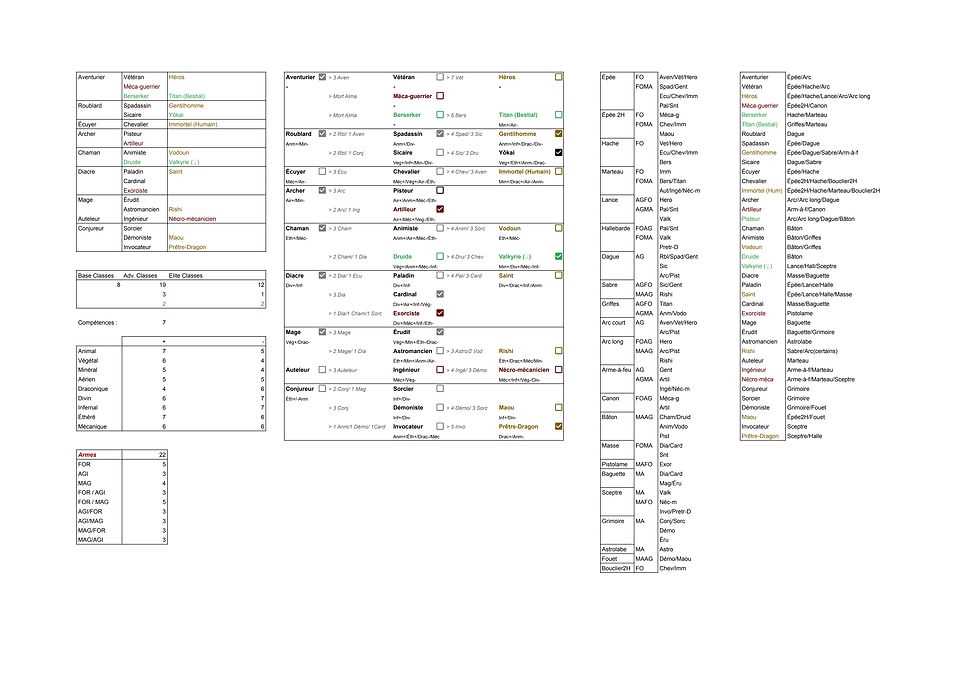
As well as the Final Fantasy Tactics aspect, the other element I wanted to explore was that of a gachamon. Apart from Pokémon Conquest in 2012, the two genres had rarely been combined, so I saw this as an opportunity to create a universe that would carve out its own niche. This led to the idea of creating creatures that would have not just a type, but a nature and an element. Thus, a water dragon and a poison dragon would not have the same weaknesses, making for even greater diversity once dual natures were implemented.

In my view, one of the keys to making the game more dynamic would be to introduce different map sizes, ranging from 1v1 for ‘tall grass’ encounters similar to Pokémon, to 2v2 and 4v4 for most basic missions, right up to 10v10 for the main story quests. And that number could rise very quickly once a team could be made up of both Guardians and Almas. One of the challenges from that point on was to come up with a speed formula that would make the stat advantageous but not excessive on overly large maps.

Then a whole bunch of other ideas, over and over again, which I tried to implement back then in UE4. (In particular, lots of conditions for interactions with the Almas, as I was so keen to break away from the rigid ‘battle-capture’ aspect of classic Pokémon.) Until I became a lecturer and then programme lead at École de Condé in Rennes, which reduced my free time to next to nothing. Here’s a jumbled overview of the painstaking progress made over the last few years.
Despite everything, I’m still hoping to produce a vertical slice in the (veeery relatively) near future.
Plot
It is worth noting that Alma and The Guardians of Cenyth share a similar universe in many respects. Although set in different Atlases, I like to think that, in a way, Alma is the prequel to The Guardians of Cenyths, set many thousands of years earlier. Or is it the other way round?
For as long as humanity can remember, the Almas have always been by its side. Sometimes threats to be avoided, sometimes a blessing in the face of danger. Sometimes a small glow by the hearth, sometimes a lifelong friend. Taking the form of many different creatures, these deities are to the Almas what the serpent is to the Caduceus of humans.
Kingdoms and cities have been built around altars worshipping the most powerful of the Almas. Liewus, the winged lynx of Scarlet; Chelua, the rocky aurochs of the City of Fire; Ieros and Galastea, the frozen soulmates of the Dogat of Gofun; Xamarcandus, the stellar tortoise of Albria; Pyrrhéa, the Phoenix whose shadow is a salamander… Fourteen in total, their power is such that those who worship them eventually come to resemble them. Thus Sabik, the Serpent of Devastation, who slumbers at the heart of his eponymous jungle, bestows scales upon his devotees, whilst the monks who pray to Semjaza are recognised by their golden skin and the winged halo on their backs
But… does this transformation really end here? What of the spirits of those who pray? The Almas bestow powers upon the humans they choose, granting them the status of Guardians, but what do they take in return? Are they truly the beings of pure generosity portrayed by the devout?
The player will begin their adventure from one of two starting points:
The first is that of a child from Orhée, a small village separated from the capital of the Kingdom of Albria by the forest. A budding adventurer trained by Akosua, a travelling mercenary and friend of his parents, our character sets off for Albria on its fourteenth birthday to take part in the Call, the ritual to which all Albrians must submit once they come of age. Praying at the city’s Echo Altars, this is the chance for every child to perhaps be chosen by an Alma. In a colourful prologue, where our hero chooses its starter and then its Faction (i.e. its starting class and the angle from which the plot will unfold), the protagonist then sets off on a very Pokemon-like quest from Altar to Altar, encountering adversaries and comrades in a relatively light-hearted atmosphere. At the very least, every adult the child meets will shield it from the truth of the plot.
Alternatively, the other option involves playing as an adult. Starting out in the working-class town of Scarlet as an Altar Keeper – a sort of mechanic-shaman responsible for the upkeep and smooth running of the Altars – the hero will soon find themselves travelling the length and breadth of the world. Whereas the child embarks on a coming-of-age quest, gradually progressing from one area to the next, the adult will quickly gain access to fast modes of transport, notably trains, in order to carry out their repair missions. And as they travel through the regions of the Kingdom in this way, the player begins to hear strange rumours: the King of Albiria’s daughter is said to be ‘cursed’, the Church of Mandorle is threatened with schism, Sabik is on the verge of awakening, and strange experiments on the Almas are taking place far to the west, in the Empire...

Without giving too much away, the idea is to offer two perspectives on the same story. This means that players who only intend to play through the game once can choose the atmosphere in which they wish to play. This will satisfy Pokémon fans who don’t want to delve too deeply into the game’s dark fantasy elements, whilst, on the other hand, those seeking a more mature storyline can immerse themselves in a far deeper narrative. Completionists, meanwhile, will benefit from a degree of replayability: a story told from two perspectives, and the impossibility of completing the plotlines of all the factions (the Kingdom of Albria, the Mandorle Church, Dharma, Dogat, Espertenthe, etc.). Certain Almas will also be restricted to the player’s age, notably one Alma that is said to reveal itself only to the purest of souls.
Almas & Characters
Here you’ll find a variety of examples of what might have been written for different elements of the game:
Liewus - The Peacock Angel, with a touch of the Lynx too (God of Wisdom and Animals)
Onomastics : "Melek Taûs" The Peacock Angel in the Yazidi religion + Lynx
It is said to have once formed a bond with a human, and has been inconsolable ever since that person’s death.
Pyrrhea - Phoenix & Salamander (Goddess of the Cycle of Life and Death)
Linked characters: Lady Talion
The Great Fire of 1133: Pyrrhea, a hellish, fiery Alma whose form shifts— sometimes a phoenix, sometimes a salamander—was suddenly consumed by fury and descended from the Northern Plains, ravaging everything in its path. Passing through the Sabik Jungle, descending from the east of the Scarlet Lands and plunging into the fields of Mandorle, it was finally a stone’s throw from the abyss, on the shores of the Great Ocean, that the beast was slain by the combined forces of the Mandorlian army and the Kingdom’s Guard. They left behind a huge crater, as well as countless dead.
1) If you face Pyrrhea with Talion in your team (or face Talion as Pyrrhea's Guardian), she will be terrified, then enraged, and will fight you to the death rather than surrender once defeated.
2) If you are allied with her but attempt to resurrect Pyrrhéa, she will leave your party.
3) However, if the conditions are met, you can trigger the quest ‘Talion’s Forgiveness’, leading Lady Talion herself to form a bond with Pyrrhea.
Lady Talion
Linked characters: Pyrrhea
Born Natalia, the daughter of peasants who perished in the Great Fire of 1133. With the disappearance of Pyrrhea robbing her of any hope of revenge, the young Natalia remained shut away in her late parents’ cottage for about ten days, venturing out only at night to relieve herself and take a few sips from the well. Sips with a lingering taste of ash. Then, nothing more. One fine morning, a young boy with a crew cut, a bundle slung over his shoulder, left his native land to enlist as a recruit in the Mandorle army.
Cold and unconcerned by the political and religious tensions that swept through Mandorle during the '40s, the woman who now called herself Talion rose through the ranks thanks to her unfailing rigour. It eventually came to light that she was a woman, but rather than take offence at this – the Mandorle army had never before had women in its command structure – the Church decided to make an example of her. At the council convened to decide whether or not to excommunicate her, Bishop Horbes declared, “It is not for men to decide who has the right to serve the deities. Leave it to our God.” She was thus exposed to Ozym’s gaze, forced to immerse herself in a pool at the heart of the Church, and… emerged unscathed. For the Church, which was in need of figureheads and muses to inspire the crowds unsettled by the very recent schism (1149), the now Lady Talion was an unexpected boon.
Horbes’s intentions at the time were not entirely clear, and remain so to this day, but Talion is grateful to him for having championed her cause when he was under no obligation to do so.
Naarok/Rokkva - The Ender (God of Cataclysms)
Linked characters: Tao
A two-headed giant, or two entities forming a single being. Together, they constitute Ragnarok, ‘the destruction of the gods’, or Ragnarokkr, ‘the twilight of the gods’.
It is the one who will be tasked with destroying this world should it ever, by the gods’ decree, become an absolute necessity.
Tao
Linked Almas : Naarok/Rokkva
The undisputed leader of the rebels, this former soldier of the Empire—which he now hates with a passion—rules the Arena of the Five with an iron fist. Situated in a rift not far from the statues of the Five Giants and extending right beneath Mandorle itself, it is a vast underground complex used for contraband and to shelter refugees from the Empire.
In exchange for compensation, he and his elite team specialise in acting as ‘smugglers’, enabling those who wish to do so to cross the border between the Empire and the Kingdom in complete safety.
Tao is no saint. Nor is he bloodthirsty. He is a man who swings between being ruthless and good-natured, depending on who he is facing. Having fought in numerous wars – one of which led to the execution of his own people – and having witnessed the misery of life as an orphan, he understands the importance that he and the community hold for the children in their midst. For better or for worse, Tao feels a duty to protect them. And all the more so given the Church’s growing abuses, which loom over their heads.
With a taste for drink and good food, it’s not uncommon to see him caught up in a brawl in some tavern in the slums of Mandorle, laughing and throwing punches as the beers flow. He also frequently organises his own arena tournaments. Legend has it that it is the blood of the deities of the Great West flowing through his veins that makes him so invincible.
One of the last ‘sons’ of Naarok & Rokkva.
Archbishop Horbes
Linked Almas : Ozym, the Mad God
Still a bishop at the time of Lady Talion’s investiture, Mandorle’s now most prominent leader is an elderly figure who is not as indoctrinated as one might think. He does, of course, harbour a genuine faith in his god, yet he is fully aware of Ozym’s deviation from the true path. He simply believes that it is not man’s place to meddle in the affairs of the gods, and that his duty is to protect his flock. Which, should you ever find yourself opposing him, makes him far more dangerous than a mere fanatic.
Ozym, Mad God
Linked characters : Archbishop Horbes
Ozym takes the form of a dragon ridden by a human figure. The two have merged, symbolising the long-standing relationship between Ozym and his followers, but also ultimately explaining the madness that eventually consumed both parties.
Ozym the Mad God, for his part, appears to be showing his age. His limbs are misshapen, and the human form seems to be gradually ‘melting’ into the body of the Beast.
Ferreol
One of the ‘Sabik’s Rejects’, and particularly hostile towards the Kingdom, he embodies everything the puritans abhor: indeed, Ferreol bears not one Stigmata, but two! With wolf-like ears and fur resulting from his first Stigmata, fine scales have begun to appear on his face, arms and chest, betraying Sabik’s hold over him.
If you do not recruit him to your team early on, Ferreol will join the forces of the Empire when it incites the Sabik’s Rejects to revolt, as well as the “Awakening” of this devastating Alma.
"One day, Ozym went to his brothers and explained its dilemma. It had taken an unusual but thriving species under its wing. They were prone to wonders and conflicts – too much so, at least, for them to coexist within the realm of the sages. Ozym therefore asked them humbly if they could help to create a place to shelter them. Fourteen of the fifteen gods agreed.
Xamarcandus split open its shell, and from its hollow the Earth was born. But the effort was so great that, whilst Ieros and Galastea covered the world with water, the Tortoise fell asleep, leaving only the tip of its tail visible. Chelua brought forth volcanoes and continents, whilst Sabik—though usually so lazy—coiled himself around the highest peaks to make the grasses spring forth. The vegetation ran wild. Zelkhaya and Zelsiro, an arrogant pair of twins, clashed to colour the skies according to their own tastes, making two moons and a sun the witnesses to their squabble. And while Ozym led the humans to this earth they would now call their own, Semjaza the Fallen Watcher and Alkhion, the Demon’s child, descended from their perch to watch over this new cradle. Semjaza leaned down first and wished them to be just and to believe in their convictions. Alkhion, to everyone’s surprise, remained silent. He simply sat by their bedside, ready to take them in his arms and stroke their hair. When sleep came.
The sagacious Liewus climbed down from a tree with amaranth-red foliage and seized a small human, whom he carried off into the air. Then, after flying far enough to leave them isolated, it set the child down by the banks of a river. Liewus and the child. Pointing to their reflection in the water, the deity asked him what he could see. What his counterpart replied, no one knows. However, the answer must have pleased the Peacock Angel: fluttering his feathers for a brief moment, it surrounded the child with animals both large and small. Pyrrhea, for her part, paused her own cycle for a moment to bless all creatures with her breath. Offering the youngest the choice to be born, and the oldest the right to depart and rest. But now that life was taking its course, the fear of the end stirred people’s hearts. So Freyj bestowed upon each person a destiny and a chance to brave it, whilst the two-headed Giant took it upon himself to protect her from those who would curse her. Then, L’zarch did what only he could do. With a snap of his fingers, he set the heavy clock of time in motion. And, suddenly, this world could exist.” The Origin of the World - Espertenthe Library
Examples of quests
MSQ : The Portable Altar
Available immediately for the Adult and a little later for the Child, this quest encourages the player to explore the map in search of these Major Altars. It serves as a sort of introduction to the environments and the finer points of gameplay, as well as a prelude to the more serious plot developments.
It is shorter for the Adult than for the Child, who does not have the same ease of movement.
I - The Children's Altar Quest
A boy who is busy at the entrance to a village. He ignores you, and as he remarks you, tells you to get lost. His hands are covered in dirt. Then, on a second visit, you find that same child in tears in the village. He tells you that he’s been linked to an Alma since birth, that he’s always lived by its side, but that it eventually disappeared. He’s afraid the Alma may have been killed or forcibly taken away, and so wants to build an Altar to commemorate it (the village is far from any Altar Keeper shop and he has no way of paying for it). So he has gathered a collection of mementos that he shares with the Alma – a jumble of bits and bobs made of stones, toys and so on, all tied together with thick string.
Quest trigger:
> Adult: He ignores you at first, but on your second visit he tells you everything when he realises you are an Altar Keeper. You can then help him ‘improve’ the Altar, whilst warning him that the Alma might not come, or that it could take some time. The child prays, but nothing happens. Once he’s left, disappointed, you can synchronise there and return to tell him the news.
> Child: He responds readily at first, but becomes wary as soon as he realises you’re an Adventurer, and then runs away from you. You’ll need to catch him in the middle of the night, sobbing, to become part of the story (you’ll have to sneak up behind him from his hiding place so he doesn’t run away). You head to the place where you first met him and discover an ‘Altar’ in the undergrowth – a contraption far too crude to possibly work. But as you hear the boy’s sobs again, you spot a faint glow through the trees. Following it, you make out an Alma fighting off others. A fight breaks out; you must protect the Alma. Once the fight is over, you bring the terrified Alma back to the lad. A tearful reunion. After he’s thanked you, if you return to the Altar, you’ll notice that it has started to shimmer slightly.
II - The Chimney Quest
A homeowner found his fireplace had turned into an I.A (Individual Altar) over the winter, now inhabited by an Alma keen to keep warm. The problem is, spring has flown by and summer is approaching, yet the Alma still wants the fireplace to be lit… much to the homeowner’s dismay. He is therefore calling on you to sort out the problem, as he doesn’t want to hurt the Alma, having befriended it despite everything.
Solution 1: A small miniature fireplace or a necklace to wear
Solution 2: Convince it to leave
Solution 3: Scare it away after fighting it – Adventurers only
III - In Search of Another Time
During your first visits to the Orhée Forest – at the very start of the game for the Child, and a little later for the Adult – you’ll find a broken altar in the heart of the forest.
Similarly, as you venture into the depths of the Crystal Marsh, you’ll come across ‘End of the World’, a sort of cliff rising up at the edge of an endless abyss. It can be reached via a rope bridge that also hangs over the void. Except that there’s nothing there.
To do this, you’ll need to find a way to repair the Broken Altar in the Forest of Orhée, and once that’s done, when you return to the Crystal Marsh, the Altar of Another Time will have appeared… also causing the appearance of a certain Alma, forgotten for eons!
IV - The Mill and the Stone Egg
A few metres from this mill – destroyed by Pyrrhea’s fury years ago and since overgrown with vegetation – lies a huge rock shaped like an egg or a mushroom. Legend has it that whoever manages to make it tremble might encounter a very special being.
As you approach the stone, you’ll be prompted to use an item. Most, of course, will have no effect; one or two will cause it to flee. But with the right one, the mill and the ruins will come back to life as the sun sets (Chihiro vibes). The Alma will then confront you.
VI - Chain Quest Gourmet Hunter
There are ordinary animals and special animals/monsters (which can become Almas). In theory, every living being has the potential to become an Alma, but as an extreme stimulus is required, ordinary animals and plants have a lower chance of doing so than monsters.
A strange individual roams the world in search of new culinary experiences. His quest takes him from monster to monster, until he reaches the point of no return: can an Alma taste good?
VI A - Chain Quest - Crystallisation
It is common knowledge that monsters in agony or experiencing extremely intense emotion can undergo ‘almification’, leaving their physical bodies to become this higher spirit.
However, legend has it that this ‘almification’ is sometimes ‘granted’ to exceptional beings who have lived long, dignified and sincere lives. This phenomenon, the authenticity of which has not been proven, is nevertheless said to be known as ‘Crystallisation’.
A quest to prove the existence of this phenomenon.
(...)
VI D - Chain Final Quest - The Alhuman
Ozym is known for his humanoid form. Is it out of human pride that he is depicted in this way? Did he take on this appearance so that his followers might more readily adhere to his precepts?
The recently confirmed phenomenon of Crystallisation has reignited the debate: did Ozym once live as a human? Was a human being ever granted the right to dwell amongst the gods?